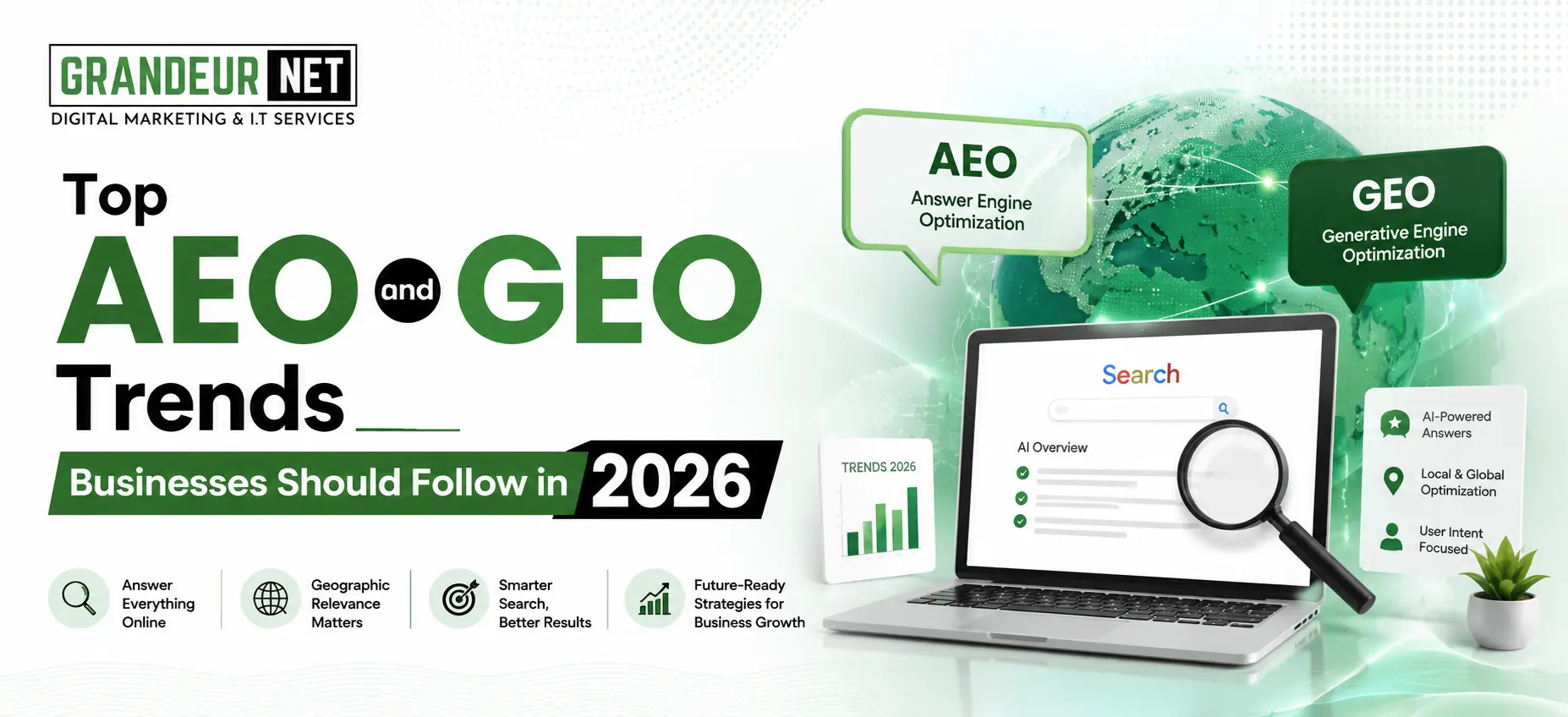
Top AEO and GEO Trends Businesses Should Follow in 2026
Quick answer: In 2026, the biggest AEO and GEO trends are answer-first content structuring, entity clarity across the web, AI visibility tracking, third-party citation building, multi-platform optimization (ChatGPT, Perplexity, Gemini, Copilot, AI Overviews), and blending AEO/GEO with traditional SEO instead of treating them as separate playbooks. Businesses that ignore this shift risk becoming invisible in AI-generated answers, even if they still rank on page one of Google.
Search doesn't look like it used to. People aren't just typing keywords into a box and scrolling through blue links anymore — they're asking ChatGPT, Perplexity, and Google's AI Overviews direct questions and expecting a direct answer. And that answer either includes your brand, or it doesn't.
That's the whole game now. Not "where do you rank," but "did the AI mention you at all."
This is where Answer Engine Optimization (AEO) and Generative Engine Optimization (GEO) come in. If you're a business owner, marketer, or content lead trying to figure out what actually matters heading into 2026, here's what's real, what's hype, and what to prioritize.
What's the Difference Between AEO and GEO, Really?
Honestly? Less than most marketing blogs make it sound. Answer Engine Optimization is about structuring your content so it can be pulled directly into a featured snippet, a knowledge panel, or an AI Overview — think clear headers, tight answers, and scannable formatting. Generative Engine Optimization is a bit broader: it's about shaping how AI tools like ChatGPT, Claude, and Perplexity talk about your brand when they generate a response from scratch, often pulling from sources that aren't even your own website.
A lot of practitioners now treat AEO and GEO as two names for the same underlying discipline — getting cited, quoted, and trusted by machines. If you want a simple mental model: SEO gets your page discovered, AEO gets your answer extracted, GEO gets your brand recommended. In 2026, you need all three working together, not competing for budget.
Trend 1: Answer-First Content Is Non-Negotiable
The single biggest AEO strategy for businesses right now is restructuring content so the answer comes immediately after the question — no throat-clearing, no three paragraphs of backstory before you get to the point. AI systems reward content that's easy to lift and reuse: clear headings phrased as questions, short direct answers, bullet points, comparison tables, and FAQ blocks. If a human has to scroll to find your answer, so does the crawler summarizing your page for an AI response.
Trend 2: Entity Clarity Matters More Than Keywords
AI models don't just match keywords — they identify entities. Before an AI system decides whether to cite your business, it's trying to figure out what your business actually is: a brand, a product, a service category, a local provider. That means consistent naming across your website, directories, social profiles, and third-party mentions, plus structured data (schema markup) that spells out who you are in a language machines can parse. Claiming your knowledge panel and keeping your business details identical everywhere is no longer an SEO nice-to-have — it's core GEO infrastructure.
Trend 3: Third-Party Citations Outweigh Your Own Website
This one surprises a lot of business owners: a large share of brand mentions in AI search now come from pages you don't own — review sites, comparison articles, community forums, guest posts, and industry roundups, rather than your homepage. That flips the old SEO instinct of "optimize your own site and you're done." GEO strategies for businesses in 2026 increasingly mean actively building a presence across the web — getting mentioned in credible third-party content — because that's disproportionately where generative engines pull their citations from.
Trend 4: Local and Geographic Signals Are Getting Sharper
People searching through AI assistants are getting specific — asking for services "near me" or in a particular city, and expecting a personalized, location-aware answer. For service businesses, that means local landing pages with clear location, service-area, and availability details aren't just for local SEO anymore; they're feeding a second discovery channel entirely.
Trend 5: You Have to Actually Measure AI Visibility
You can't improve what you can't see, and for a long time nobody could see how often their brand showed up inside an AI answer. That's changed. Tracking citation rate across ChatGPT, Gemini, Perplexity, and Copilot — and treating it as its own metric, separate from organic rankings — is quickly becoming standard practice. Expect AI visibility dashboards to become as normal in 2026 as rank trackers were a decade ago.
Trend 6: Platform-Specific Nuance Is Real
Not every answer engine behaves the same way. Google's AI Overviews still lean heavily on top-ranking organic results, so traditional SEO groundwork still matters there. Perplexity tends to reward freshness and multi-channel authority. Microsoft Copilot leans on LinkedIn for B2B queries. Some LLMs favor long-form, comprehensive guides over short snippets. A one-size-fits-all AI search optimization strategy will underperform — the smarter move is a holistic content and authority strategy that happens to travel well across all of them.
Trend 7: SEO, AEO, and GEO Are Merging Into One Discipline
Maybe the most important shift for 2026: businesses are done treating AEO and GEO as side projects bolted onto their existing SEO team. The winning approach folds them together — technical SEO foundations, answer-ready formatting, and AI-trust signals like credibility, freshness, and citations, all managed as one visibility strategy instead of three competing budgets.
Frequently Asked Questions
-Do I need to drop SEO to focus on AEO and GEO?
No. Traditional SEO still drives a meaningful share of traffic and remains the foundation many AI Overviews pull from. AEO and GEO extend your visibility strategy — they don't replace it.
-Is GEO only for large enterprises?
Not anymore. While enterprise platforms exist for tracking AI citations at scale, small and mid-size businesses can apply the same core principles — answer-first content, entity consistency, and third-party mentions — without expensive tooling.
-How do I know if this is actually working?
Track referral traffic from AI platforms and periodically test how often your brand gets mentioned when you (or a tool) ask common questions in your industry across ChatGPT, Perplexity, and Google AI Overviews.
The Bottom Line
AEO and GEO trends in 2026 all point in the same direction: businesses need content that's easy for AI to extract, a brand identity that's consistent everywhere, and a genuine presence across the web — not just on their own site. Traditional search isn't going away, but it's no longer the whole picture. The businesses that treat AI search optimization as core strategy now will be the ones AI assistants are actually recommending a year from now.
If you're not sure where to start, working with a team that already lives in this space helps. Techrsv Private Limited specializes in helping businesses build exactly this kind of AI-ready visibility — from answer-first content to entity clarity to AI visibility tracking — so you're not figuring it out alone.
Need technical or growth guidance on your project?
Our solutions architects and media leads are ready to review your current tech stack and growth metrics.
Schedule Architecture Review